GREI guide
The voltage drop of a circuit
A cable that is too long or too thin lowers the voltage at the end of the circuit. The GREI requires the drop to be limited, but gives no figure itself. Here are the values used and the calculation.
What the GREI says
Section 5.2.5 of the GREI only says that voltage drops in wiring systems must be limited to the values described in codes of good practice.
The usual values: 3 % and 5 %
For an installation supplied from the public low-voltage network, codes of good practice use the values of standard HD 60364-5-52 (annex G): 3 % for lighting and 5 % for other uses, between the origin of the installation and the appliance.
These figures are not GREI articles: they are good-practice references, to be cited as such.
The calculation
In single phase, the voltage drop of a circuit is approximately:
ΔU = 2 × L × I × ρ / S
- L: the cable length, in metres, one way;
- I: the current, in amperes;
- S: the cross-section, in mm²;
- ρ: the resistivity of copper, about 0.0225 Ω·mm²/m in service.
This formula ignores the cable’s reactance, which is very small for small cross-sections.
Example: a 2.5 mm² socket circuit, 25 m long, carrying 16 A. ΔU = 2 × 25 × 16 × 0.0225 / 2.5 = 7.2 V, i.e. 3.1 % of 230 V: below 5 %.
In balanced three phase, the factor 2 becomes √3 and the result is compared with the line-to-line voltage.
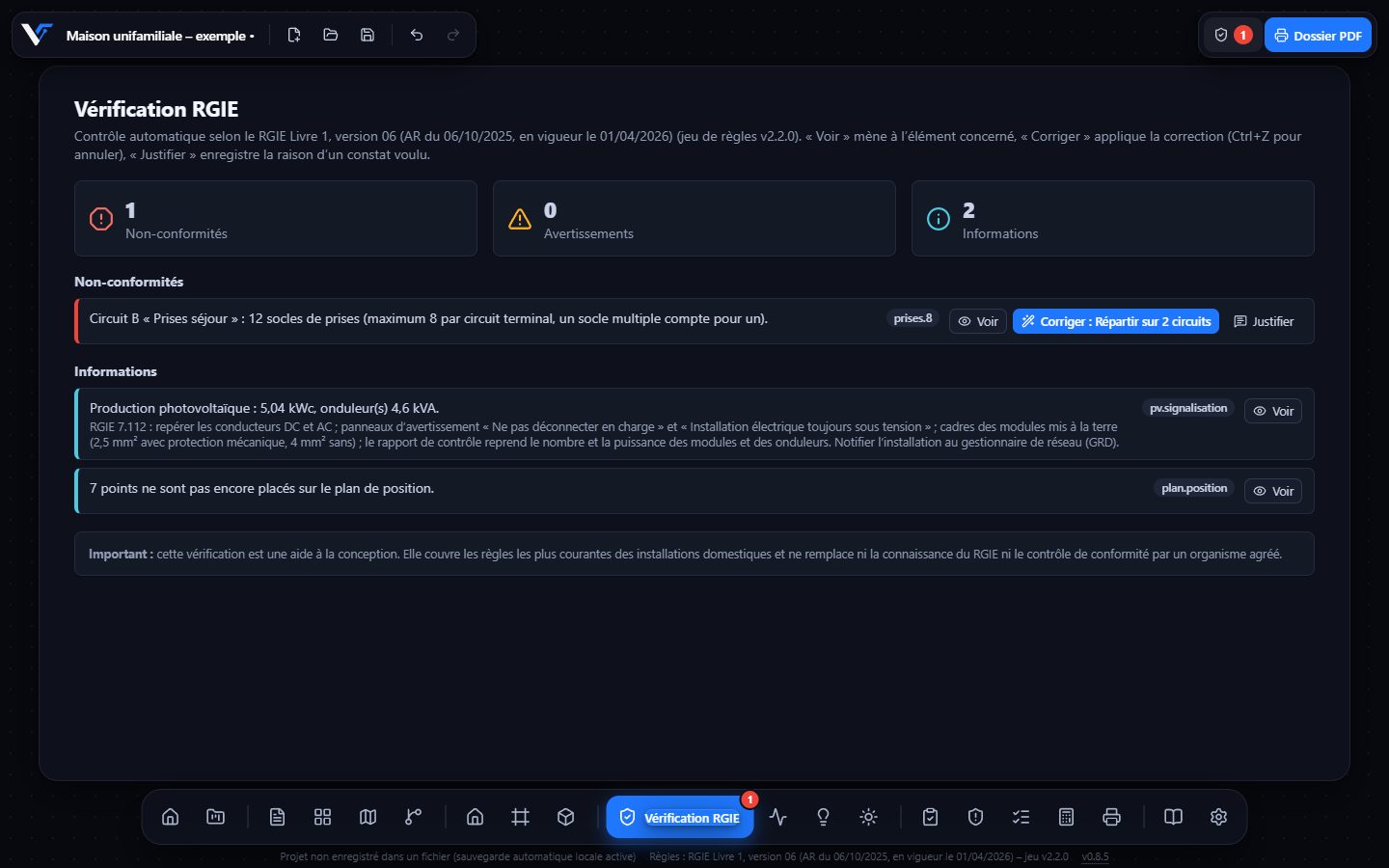
With Vonkcad
The voltage drop of every circuit, no calculator needed
- Voltage drop calculated for every circuit, from its length, cross-section and load
- Exceeding 3 % or 5 % flagged, with the source cited
- Simulation on the plan: the voltage drop at a socket
Read also
The single-line diagram
What it must contain, how circuits and points are marked, the symbols.
The layout plan
The items to show, the letter-and-number marking, keeping it up to date.
The acceptance inspection
The documents to prepare, what the approved body checks, the report.
Cable size and circuit breaker
Table 4.11: the maximum rating for each cross-section, and dedicated circuits.
RCDs
300 mA at the origin, 30 mA for sockets, lighting and the bathroom, earth electrode.
Sockets per circuit
At most 8 sockets per circuit, two lighting circuits, appliances on a separate circuit.
The bathroom
Zones 0, 1 and 2, permitted equipment, the RCD and equipotential bonding.
This guide summarises the GREI Book 1, 2026 version. Only the official text published by the FPS Economy is authoritative.
Your next file, with Vonkcad
Single-line diagram, layout plans, GREI check and PDF file: everything is linked in one project. Free during the beta.