GREI guide
The bathroom under the GREI
In a room with a bath or shower, the GREI divides the space into zones around the water. The closer you get, the more limited the permitted equipment. Here are the essentials of chapter 7.1.
The zones
Zone 0: the inside of the bath or shower tray. With no tray, or with a tray less than 10 cm deep, it extends 1.20 m around each fixed water outlet, up to 10 cm above the floor.
Zone 1: above zone 0, up to 2.25 m high, or up to the highest water outlet if that is higher. For a bath, it stops at the outer edge of the bath; for a shower, 1.20 m from each fixed water outlet. It includes the space under the bath or shower tray.
Zone 2: for a bath only, a 60 cm strip around zone 1, over the same height. A shower has no zone 2.
Fixed partitions at least 2.25 m high can limit the zones. Doors and windows within the zones are considered open.
What is allowed in each zone
- Zone 0: only fixed appliances intended for this zone, permanently connected and supplied at safety extra-low voltage (SELV), with the source outside zones 0 and 1. No socket, no junction box.
- Zone 1: fixed appliances intended for this zone and permanently connected, or SELV equipment. No low-voltage socket.
- Zone 2: fixed appliances, switches, and low-voltage sockets protected by an RCD of 10 mA at most, or each by an isolating transformer of 100 W at most.
- In zones 0, 1 and 2: no distribution board.
The degree of protection against water
Under table 7.3, equipment withstands immersion (AD7, i.e. IPX7) in zone 0, splashing water (AD4, i.e. IPX4) at least in zones 1 and 2, and dripping water (AD2, i.e. IPX2) in the rest of the room.
RCD and equipotential bonding
Bathroom circuits are protected by an RCD of 30 mA at most, placed outside the bathroom and, in domestic installations, under the main RCD (subsection 7.1.4.3).
Supplementary equipotential bonding connects the exposed-conductive-parts and the accessible conductive parts of the room: metal water and heating pipes, metal bath, metal waste pipe (subsection 7.1.4.4).
The room’s electrical wiring has no metal parts other than its conductors: no armour, no steel conduit.
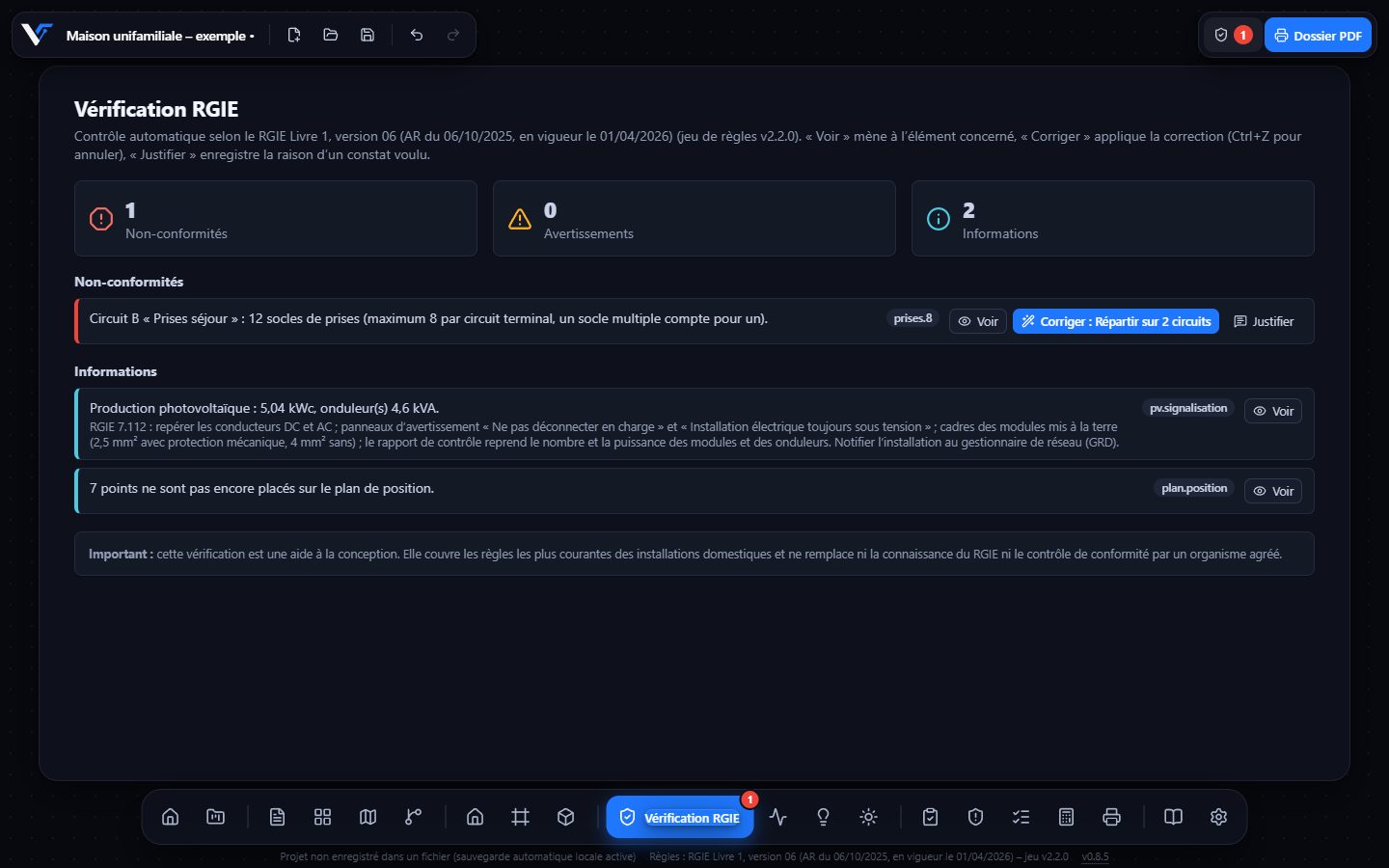
With Vonkcad
The zones on the plan, the equipment checked
- Bath and shower zones shown on the plan
- Sockets and switches checked against the zone they are placed in
- Bathroom 30 mA RCD checked
- Supplementary equipotential bonding included in the check
Read also
The single-line diagram
What it must contain, how circuits and points are marked, the symbols.
The layout plan
The items to show, the letter-and-number marking, keeping it up to date.
The acceptance inspection
The documents to prepare, what the approved body checks, the report.
Cable size and circuit breaker
Table 4.11: the maximum rating for each cross-section, and dedicated circuits.
RCDs
300 mA at the origin, 30 mA for sockets, lighting and the bathroom, earth electrode.
Sockets per circuit
At most 8 sockets per circuit, two lighting circuits, appliances on a separate circuit.
Voltage drop
What the GREI says, the 3 % and 5 % values, and the calculation with an example.
This guide summarises the GREI Book 1, 2026 version. Only the official text published by the FPS Economy is authoritative.
Your next file, with Vonkcad
Single-line diagram, layout plans, GREI check and PDF file: everything is linked in one project. Free during the beta.